
“Well, I’ve been under physical therapy and a medical doctor and a specialist for my knee for three months. And during that three months, there was really no relief ever. … With one treatment here, I can walk without pain. I can walk straight.”Susann P., a patient of Dr. Scranton
What the knee program is, and who it is for
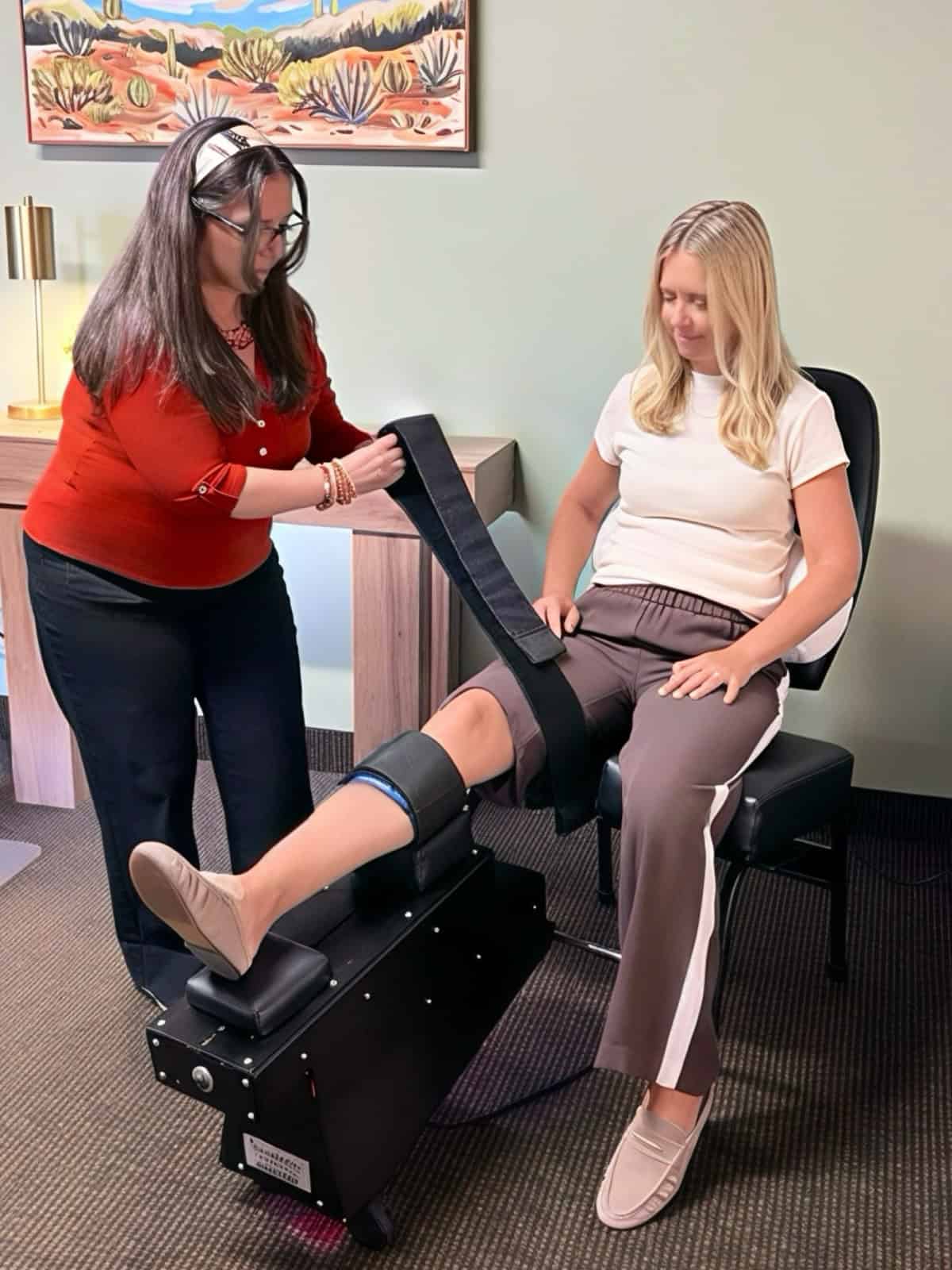
Most people who come in for their knee have already been told their options are injections, physical therapy or surgery. Some have a knee that gives way on stairs. Some have arthritis and swelling. Some have finished a course of physical therapy and are no better than when they started.
Dr. Scranton does not start at the knee. He starts with digital X-rays and a Gonstead exam of the whole chain the knee hangs off: the pelvis, the hips, the spine and the ankle. A knee that keeps collapsing is often taking the strain for a joint somewhere else, and adjusting the knee alone does nothing for that.
What the program does
- Reduces pain and swelling with specific joint adjustments and soft tissue work around the knee, rather than masking it.
- Restores range of motion by mobilising the joint and the joints above and below it, so stairs, curbs and getting out of a chair stop being a task.
- Rebuilds the muscles that hold the knee steady with exercises written for your knee, so the improvement holds.
- Fixes the mechanics that caused it, which is the part most knee treatment skips.
Before any of that, there is a complimentary test treatment. You feel how your knee responds first. Then Dr. Scranton tells you whether you qualify for the program, and if you are accepted, you get a plan written for your knee, not a standard one.
Why people choose Dr. Scranton for this
He looks before he treats
Digital X-rays on site at the first visit, read with you in the room. The Gonstead exam finds the joint that is actually causing the problem, so that is what gets treated.
He has done this for a long time
Palmer College of Chiropractic, class of 1999. More than 10,000 patients. Years spent teaching other chiropractors how to treat knee pain and neuropathy.
He tells you the truth
If he does not think he can help you, he will say so at the first visit. No plan is written that you have not agreed to. You will never be a number in this office.
What to expect at your first visit
1. You tell him what is happening. When it started, what makes it worse, what you have already tried. Nobody hurries you.
2. The exam, and X-rays if you need them. Digital X-rays are taken on site and read with you in the room. He checks the hips, the pelvis and the ankle as well as the knee.
3. A straight answer. What he found, whether he can help, and what it would take. If he does not think he can help you, he will tell you. We are not going to give you false hope.
The first visit is $47, usually $180, and covers the consultation, the exam, any X-rays you need and the conversation afterwards.
Three patients on what the knee program did for them
“In the spring my right knee began collapsing when I flexed, making stairs quite a task. … After what I’d been through I wasn’t expecting much but I was pleasantly surprised at how the adjustments helped me. … Now I can walk for longer periods of time and at a faster stride.”Anna D.
“Upon receiving my first few weeks of chiropractic care, the pain in my knee has almost completely vanished.”Alex K., a cross-country runner
Three more knee patients, on video:
Every quote is a real patient of Dr. Scranton. Results vary from person to person.
Questions people ask about knee pain and chiropractic
Can a chiropractor help knee pain, or is it only for backs?
Chiropractors adjust every joint in the body, not only the spine. Dr. Scranton has trained specifically in extremity adjusting since 1997 and spent years teaching other chiropractors how to treat knees. Knee pain often starts in the hips, pelvis or ankle, which is why the whole chain is examined, not just the knee.
What does the first visit cost?
$47, usually $180. That covers the consultation, the exam, any X-rays you need and a sit-down with Dr. Scranton to go through what they show. The complimentary test treatment for the knee program is part of finding out whether you qualify. No other price is quoted until you have been examined and agreed to a plan.
Do I need X-rays for a knee?
Usually, yes, and they are taken on site at the first visit. An X-ray shows whether the joint space, the alignment or the bones above and below the knee are part of the problem. Dr. Scranton reads them with you in the room and explains what he is seeing before he touches anything.
I have already had physical therapy and injections. Is there any point?
That is exactly who the program is for. Many patients arrive after physical therapy or injections that did not hold. The test treatment lets you feel whether a different approach changes anything before you commit, and if Dr. Scranton does not think he can help, he will say so at the first visit.
How many visits will it take?
It depends on the knee, and nobody can honestly tell you before an exam. After the X-rays and the test treatment, Dr. Scranton tells you what he found and what a plan would look like. You decide from there. Nobody is put on a plan they have not agreed to.
Do you see knee patients from Taylorsville, Kearns and West Jordan?
Yes. The clinic sits on the West Valley City and Taylorsville border, a minute off the I-215, and knee patients come from Kearns, Magna, West Jordan, South Jordan and, for this program, from much further across Utah.
Action Chiropractic is at 2964 West 4700 South #102, on the West Valley City and Taylorsville border, a minute off the I-215. We see patients from Kearns, Magna, West Jordan and South Jordan, and for the knee and neuropathy programs some drive in from across Utah.
Neuropathy program Arthritis Gonstead chiropractic care Meet Dr. Scranton Request an appointment